
You’ve served the community for years, but if your Google Business Profile only shows a handful of old reviews, new customers think you’ve closed up shop.
You have deep roots in your community. You have survived economic downturns, outlasted competitors, and built a reputation based on decades of honest, face-to-face service. By all traditional metrics, your business is a pillar of the local economy.
But in today’s market, your digital storefront is the first storefront customers visit.
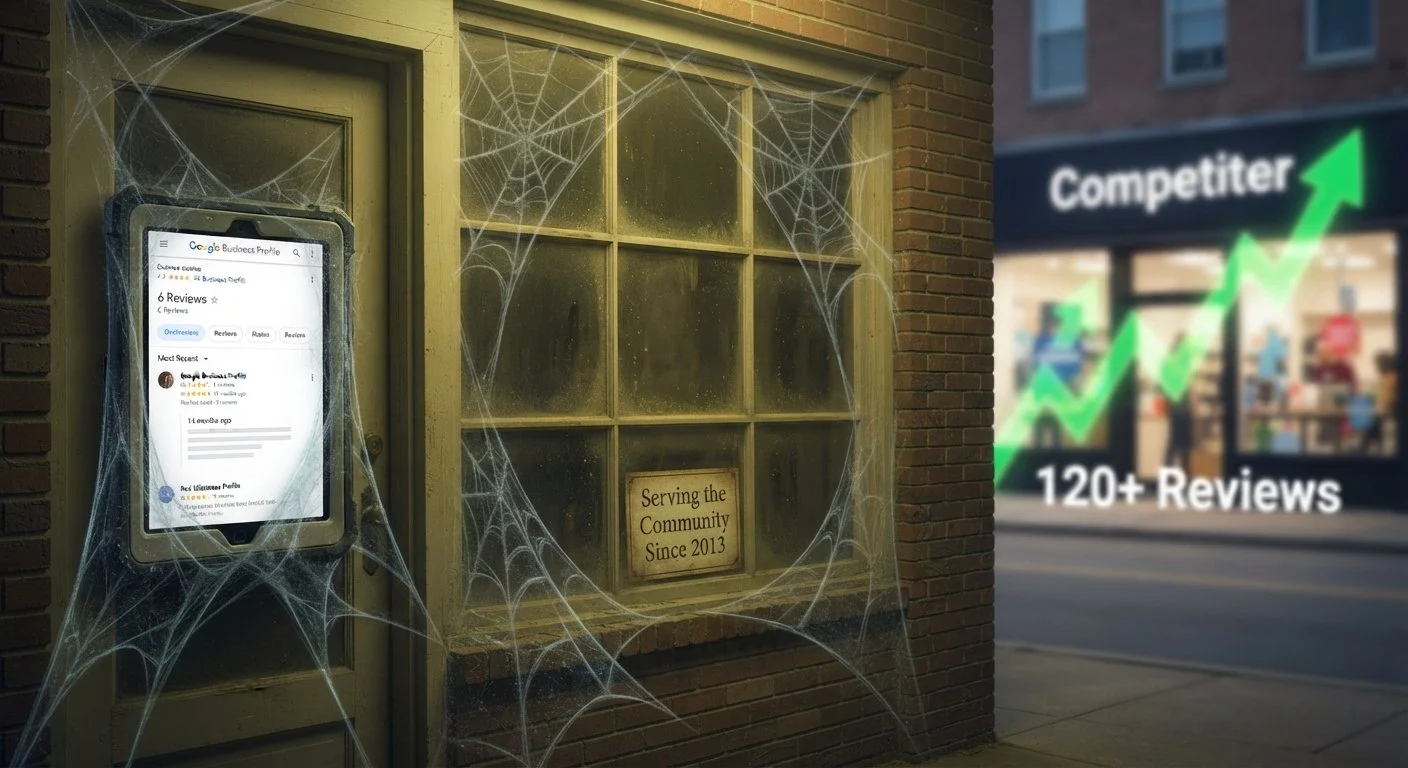
If a prospective customer searches for your services and finds your Google Business Profile (GBP)—the most important piece of digital real estate you own—and sees you have only six reviews, with the most recent one posted fourteen months ago, to that customer, you are not an established veteran.
To them, you look like a business that is either coasting on fumes, has changed ownership, or has simply become irrelevant. Here is why a stagnant, low-volume review profile is actively killing your local SEO and driving customers to your competitors.
1. Stagnancy Signals Inactivity to Google’s Algorithm
Google’s primary goal is to connect users with businesses that are open, active, and capable of serving them right now.
Google’s local search algorithm does not just look at your website; it analyzes your GBP to determine your ranking in the "Local Map Pack" (the top three results displayed on the map). One of the most critical ranking signals is Review Velocity and Recency.
If your business has been open for a decade but has a total of six reviews, and you haven't received a new review in over a year, Google’s algorithm interprets this as "stagnant."
Even if you are a great business, Google will prioritize competitors nearby who have fewer real-world years in business but have ten new reviews this month. A consistent flow of new reviews tells Google, "This business is alive, well, and providing great service today."
2. The "Trust Gap" Caused by Outdated Feedback
Put yourself in the shoes of a modern consumer. Before they call you, they look at your star rating and the dates next to the reviews.
If they see a 5.0-star rating but only a tiny number of total reviews, and the newest one is dated "last year," they immediately become suspicious. They wonder:
"Is this business still operating?"
"Did they maintain their quality standards after the pandemic?"
"Why hasn't anyone reviewed them recently?"
For an established business, a lack of recent social proof creates a "Trust Gap." It implies that past customers aren't motivated enough by your service to recommend you publicly. A profile with only a few fossilized reviews makes your decade of experience look like a decade of decline.
3. How Quantity Protects Your Hard-Earned Reputation
Over a long enough timeline—like ten years in business—a negative review is statistically inevitable. It happens to the best of us.
The only way to protect your hard-earned reputation from the occasional unavoidable 1-star review is to dilute it with a large volume of positive experiences.
If you only have six reviews, a single disgruntled customer leaving a 1-star rating tanks your average to a 3.8 or lower. This scares off new customers instantly. If you have a healthy, growing number of reviews, that same 1-star review is viewed as an outlier by prospective clients, which is the reality for most stable businesses.
Translate Real-World Success to Digital Credibility
You have spent years building a successful, real-world business. It is time to ensure your digital presence reflects that reality.
Relying on six old reviews is not just a missed opportunity; it is a liability that is actively hurting your visibility on Google Maps and handing leads to more digitally active competitors.
It costs nothing to ask happy customers for feedback, but the cost of having a dormant online reputation is immeasurable. Revitalize your local SEO by building a system to continuously generate fresh reviews starting today.