
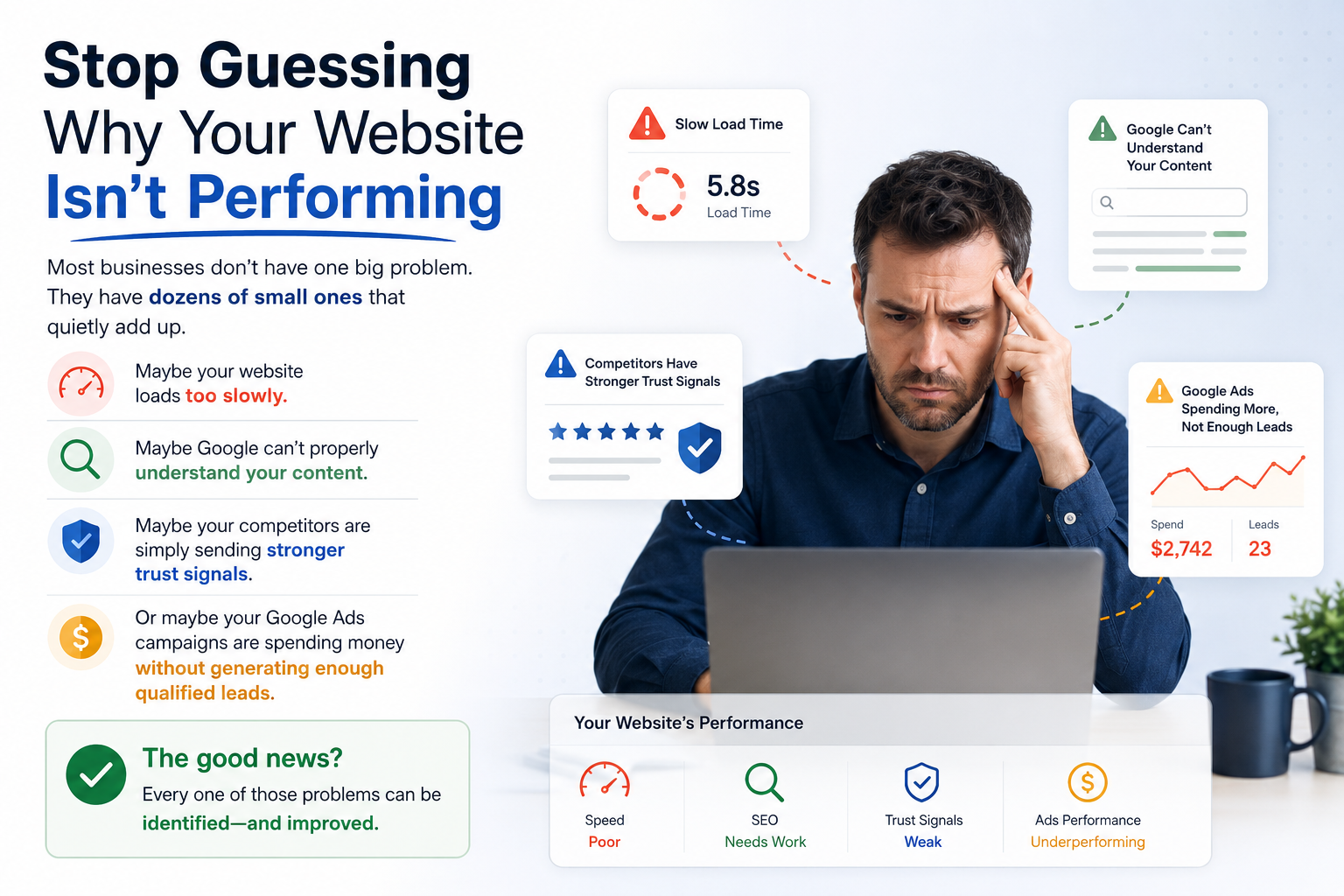
Having a website is only the beginning. Learn the most common reasons businesses struggle to rank in Google Search—and the practical steps you can take to improve your online visibility.
You launched your website.
You added your services.
You may have even written a few blog posts.
So why isn't your business showing up in Google when potential customers are searching for exactly what you offer?
It's a frustrating question—and one I hear often.
The truth is, simply having a website doesn't guarantee visibility. Google evaluates millions of web pages every day, looking for the ones that provide the best experience, the most relevant information, and the strongest signals of trust.
If your website isn't appearing where you expect, it's usually not because Google has ignored you. More often, there are underlying issues that can be identified and improved.
Let's look at the most common reasons businesses struggle to rank—and what you can do about them.
Your Website May Have Technical SEO Issues
Think of technical SEO as your website's foundation.
Visitors might never notice it when everything is working correctly, but search engines certainly do.
Technical issues can make it difficult for Google to crawl, understand, or index your website properly.
Common problems include:
Pages blocked from indexing
Broken links or redirects
Duplicate content
Missing metadata
Poor internal linking
Missing structured data (schema)
Mobile usability issues
Even the most beautifully designed website can struggle in search results if Google can't efficiently understand its content.
The good news is that many technical SEO issues are fixable—and once they're addressed, they often create a stronger foundation for future growth.
Website Speed Matters More Than Most Businesses Realize
One of the biggest performance issues I see is slow websites.
This is especially common with image-heavy sites like photographers, contractors, interior designers, and online retailers.
Large images, unnecessary scripts, and outdated plugins can dramatically increase load times.
When pages load slowly:
Visitors become impatient.
Bounce rates increase.
Conversion rates often decrease.
Search engines receive signals that users aren't having a great experience.
A fast website benefits everyone.
Your visitors stay engaged longer, and Google has an easier time crawling and evaluating your pages.
Website speed alone won't get you to the top of the rankings—but ignoring it can certainly hold you back.
Great Content Starts With Search Intent
One of the biggest misconceptions about SEO is that it's all about keywords.
Keywords matter.
But understanding why someone is searching matters even more.
Ask yourself:
Does this page answer a specific question?
Is the information genuinely helpful?
Would someone leave the page feeling like they found what they needed?
Google has become remarkably good at identifying content that demonstrates real expertise.
Businesses that publish thoughtful, useful content generally perform better than those relying on short, generic service pages filled with repetitive keywords.
Instead of writing for search engines, write for your customers—and organize your content in a way that helps Google understand it.
Local SEO Can Make or Break a Business
If you serve customers in a specific city or region, local SEO should be one of your highest priorities.
That includes more than simply listing your address on your website.
A strong local presence often includes:
A fully optimized Google Business Profile
Consistent business information across the web
Positive customer reviews
Location-specific service pages
Original photos
Updated business hours and services
Many businesses focus heavily on their website while neglecting their Google Business Profile, even though it's often the first thing potential customers see.
Your local presence and your website should work together—not compete with one another.
Your Website Needs to Build Trust
Google's goal is to recommend businesses that appear reliable, knowledgeable, and legitimate.
Your website should reinforce that trust.
Simple improvements can make a significant difference:
Clear contact information
Easy navigation
Helpful FAQs
Testimonials and reviews
Professional photography
Detailed service descriptions
Secure HTTPS browsing
Visitors often decide within seconds whether they trust a business enough to continue exploring.
Google pays attention to those behaviors, too.
SEO Isn't a One-Time Project
One of the biggest myths surrounding SEO is that you optimize a website once and you're finished.
In reality, search is constantly evolving.
Competitors update their websites.
Google refines its algorithms.
Customer behavior changes.
Your business grows.
The websites that consistently perform well are usually the ones that continue improving over time.
That doesn't mean making changes every week.
It means reviewing your website regularly, updating outdated information, expanding helpful content, improving technical performance, and adapting as your business evolves.
SEO is an ongoing investment in your online visibility.
The Good News: Most SEO Problems Can Be Fixed
Many business owners assume that poor rankings mean they need a brand-new website.
Often, that's not the case.
Sometimes the biggest improvements come from fixing technical issues, improving page speed, strengthening content, or optimizing local search signals.
Small changes can create meaningful results when they're focused on the right areas.
The challenge is knowing where to start.
Wondering What's Holding Your Website Back?
Every website has opportunities for improvement.
The question is identifying which ones will make the biggest difference.
That's why I offer a Free SEO Analysis.
You'll receive a personalized review covering:
🔍 Technical SEO
⚡ Website speed
📍 Local SEO opportunities
📄 Content quality
📈 Search visibility
🚨 Quick-win recommendations
This isn't an automated report filled with confusing metrics.
It's a practical review designed to help you understand what's working, what's limiting your visibility, and where you can focus your efforts first.
Whether you choose to make the improvements yourself or work with a professional, you'll leave with a clearer understanding of your website's strengths and opportunities.
Because successful SEO isn't about chasing algorithms.
It's about creating a website that's valuable to your customers—and easy for Google to understand.